
Failure

The Fail Faire DC 2011 Impact: A Renaissance of Failure in ICT4D

failfairedc

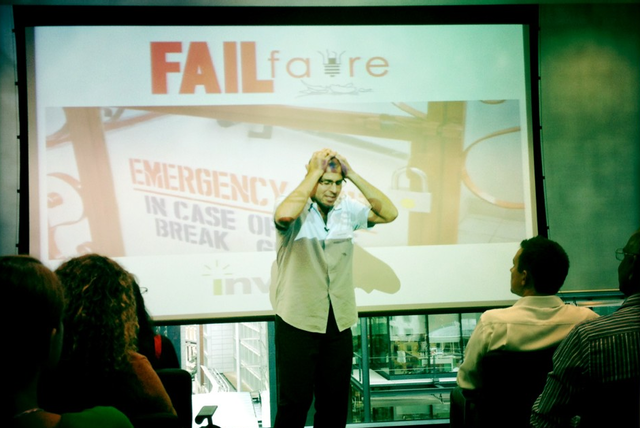
Two weeks ago, ICTworks led the organization of Fail Faire DC, an amazing celebration of failure as a mark of leadership, innovation, and risk-taking in pushing the boundaries of what is possible in scaling ideas from pilots to global programs.

Sign up to get alerts on future Fail Faire DC events

Our goal was to continue the Fail Faire movement started by Mobile Active, and make failure more acceptable in the international development community. So far, the impact of Fail Faire DC 2011 is greater than we anticipated. Yes, the event itself was amazing, and others agree, but more importantly, it spawned a greater conversation around failure and the need to fail if we are to expand our profession.

failure-ict.jpg

Here is a quick tour of the Fail Faire DC impact to date:

  1. Learn about the 10 levels of ICT4D failure, including the "epic fail", better know as the face palm
  2. Check out the FailFaireDC photos on Flickr. Relive your favorite slides and remember your favorite presenters.
  3. Read the Slate.com article. We had a great write up, complete with the academic underpinnings to our erstwhile activities.
  4. Read a presenter's first-person account. Tessie San Martin, CEO of Plan International USA was a FailfaireDC presenter and is proud of her failures
  5. Learn how NOT to plan a FailFaire. Ian Thorpe explains that going big is not a path to success
  6. And how to fail successfully. Or that's the boast from NDI Tech, who somehow failed to attend FailfaireDC.
  7. Join Admitting Aid Failure, the second Aid Blog Forum. The aid bloggers are taking our idea to the Internets.
  8. While "just say no" to admitting failure is the American Public Health Association's contribution, as talking about failure might scare off donors
  9. Yet EWB admits failure annually and still somehow gains funding and buzz
  10. Look for a FailFaireNYC. Mobile Active is teaming with Unicef to have a FailFaire in New York City this December.

Most of all, remember to fail in everything you do. Only then are you showing leadership and innovation in pushing the boundaries of what is possible in scaling ICT and international development.


.

Get ICTworks 3x a week - enter your email address:

Wayan Vota's picture

Wayan Vota

Inveneo

Wayan Vota is a technology expert focused on appropriate information and communication technologies (ICT) for rural and underserved areas of the developing world. He is a Senior Director at Inveneo and is the editor of ICTworks

If You're Not Failing at ICT4D, You're Not Trying Hard Enough

The word failure has always held a negative connotation. It makes sense. Failure represents effort, time, and money that did not produce results: a largely negative return on investment. No individual or group ever wants to feel that work has been wasted.

But why do we have to view failure as a waste of effort, time, and money? Failure brings to light some glaring faults in project planning and implementation, and taking advantage of these lessons can greatly improve the way future projects are managed.

This was the viewpoint taken by ICT4D professionals attending Fail Faire DC at the World Bank on October 13. The event looked to celebrate the failures in ICT implementation by development organizations as an indication of leadership, innovation, and risk-taking in pushing the boundaries of what is possible in scaling ideas from pilots to global programs.

Sponsored by the World Bank, Development Gateway, Inveneo, Jhpiego, and Facilitating Change, the Fail Faire brought together individuals in ICT4D to openly and lightheartedly discuss their failures and collaborate about ways to avoid similar setbacks in the future.

Sign up to get alerts on future Fail Faire DC events

The night began with some networking in a World Bank lobby. With ICT4D being such a tight-knit community, this gave many a chance to catch up with old professional friends. Soon, everyone congregated in the conference room and Wayan Vota opened the celebration, reminding the audience that Steve Jobs, an ICT legend made the majority of his income at Pixar, a point in his life considered his greatest failure.

Presentations

  1. Kristin Peterson of Inveneo began the presentations, discussing problems they encountered by making assumptions on existing infrastructure and end user knowledge before project implementation. They told about lizards and killer bees nesting in their hardware, learning soon after that honey conducts electricity.

  2. Allison Stone from MoTech then took the floor, talking about her organization’s failure in implementing a mobile phone powered data collection system for nurses in Northern Ghana. The nurses did not want, and in some cases, did not know how to enter data into the phones, and a solution that did not incorporate technology turned out to be the best one.

  3. Following this, Erin Mote, a lively and animated presenter, told the audience about USAID’s Partnership for an HIV-Free Generation program. In this case, USAID spent $40 million on a gaming program to teach students in Sub-Saharan Africa about the prevention of HIV. With the game servicing 2500 players on 15 computers, the project cost about $16,000 per player. Since this, USAID has spent more time in researching the end users, determining stakeholders, and developing proofs of concept.

  4. Tessie San Martin from Plan International told the audience about their CRM systems: “It looks like a CRM system, but inside there’s just some tired birds chipping away.” She then went on to talk about trying to implement FrontlineSMS. They didn’t realize that a certain type of phone was needed, and all of the phones they purchased were the wrong ones. Because that team was too embarrassed to talk about its failure, another team bought the wrong phones again for a different FronlineSMS project. San Martin ended her presentation reminding us that, “The only failure that will kill you is the failure to learn.”

  5. Andrea Bosch from Creative Associates talked about implementing a radio project in Bolivia. After leaving the radio programming documentation with users for a few days, they soon after found their documentation appearing in local markets. Apparently international property rights may be needed in ICT4D projects.

  6. Next up, Samia Wilhem from the World Bank talked about their recent admittance of a 70% failure rate in ICT projects. A lack consistent ICT expenditure tracking outside of the ICT department, along with departments working in silos, often led to project failures. She pointed out that according to Richard Heeks, all major ICT4D projects represent 35% total failure, 50% partial failure, and 15% success.

  7. After admitting failure to remember his wedding anniversary, Sean Dewitt told the audience about an extremely successful village phone program implemented by the Grameen Foundation. Jokingly, Dewitt reported, “So what do you do when you have a program model that is working really well? You abandon it!” Grameen split their team in two, one dealing with innovation and the other dealing with ethnographic research and project replication. It turned out that failure resulted from not integrating the human network with the development team.

  8. Dr. Harshad Sanghvi of Jhpiego discussed brain drain, where skilled professionals emigrate away from developing regions in search of better living conditions. He makes the point that, by viewing human resources as a commodity, there is no brain drain. “In Kenya we drink the best coffee in the world and then send it to you. I’ve never heard of a coffee drain.” He then warned against solving pre-determined problems instead of searching for the root cause of a problem.

  9. Following this, Jacobo Quintanilla from Internews advised the audience to be realistic, do their homework, interact with end users, and assess when implementing ICT4D projects. He warned, “Brothers and sisters, emergencies are not the best time to test your new technology,” and suggested to invest in preparedness for emergencies. He pushed the point that technology is not always the best solution, and new technologies are not always appropriate.

  10. Gerard Pohl from Development Gateway presented “100 Million IT Failures per Month,” telling how just last week an unrecognizable pop-up from an anti-virus scammer led to a blue screen of death. He pointed out how internal IT problems add up and cause setbacks in day-to-day functioning.

  11. Finally, Brian Forde presented on how Llamadas Helada’s biggest perceived success was in fact its biggest commercial failure. Even though their project of expanding low-cost phone access across Nicaragua using bicycle-based phones generated a great deal of media attention, it did not anticipate all of the user wants and needs. He warned against replicating his pedal-powered failure by attempting to use “holy water to wash away business model sins”. Projects always need customer demand first.

At the end of the night an XO laptop was presented to Erin Mote from USAID for best ICT4D failure. All in all, the night maintained a light-hearted atmosphere with a lot of laughs while creating an atmosphere of acceptance in failing.


.

Get ICTworks 3x a week - enter your email address:

lindsaypoirier's picture

Lindsay Poirier

I am an undergraduate student at Rensselaer Polytechnic Institute studying Information Technology and Science, Technology, and Society. The focus of my studies is on International Development. I have a particular interest in incorporating ICTs in primary education in Sub-Saharan Africa.

Fail Faire DC 2011 - a celebration of failure

Fail Faire DC 2011 is a celebration of failure as a mark of innovation and risk-taking. We will have great speakers with fun, fast, Ignite-style presentations of their professional failures. Audience participation is not only encouraged, it is mandatory! We are all peers and none of us is perfect. Expect much laughter as we navel-gaze at where we have all gone wrong in ICT and international development.

Yet we will LEARN from failure. Failure is no reason to be ashamed. Failure shows leadership, innovation, and risk-taking in pushing the boundaries of what is possible in scaling ideas from pilots to global programs. There is great value in examining our mistakes as we go beyond the easy and the simple. So while we encourage irreverence and humor, we will be improving our profession too.

Fail Faire DC 2011 will happen on October 13th at the World Bank. The event is sold out already (in 5 hours!) and there is only one way in now - present.

Fail Faire DC 2011 is brought to you by theWorld Bank, Development Gateway, Inveneo, and Jhpiego.

Fail Faire DC 2011 Sponsors

Agenda:

  • 6:00pm: Welcome and drinks
  • 6:30pm: #FAIL-Slam
  • 7:30pm: Open Discussion
  • 8:00pm: Mingling, learning, networking, more drinks

.
Featured Speakers (so far)

  • Dr. Tessie San Martin, CEO, Plan International USA
  • Ian Schuler, Internet Freedom Programs, U.S. Department of State
  • Erin Mote, Chief of Party, USAID Global Broadband and Innovations Alliance
  • Andrea Bosch, ICT Advisor and Chief of Party, TILO Egypt, Creative Associates
  • Dr. Harshad Sanghvi, Vice President of Innovations & Medical Director, Jhpiego
  • Kristin Peterson, CEO & Co-founder, Inveneo
  • The World Bank on their 70% ICT4D failure rate
  • Grameen Foundation
  • Development Gateway
  • You? Apply today!

.
We're sold out already so sign up to get alerts and updates about this and future Fail Faire DC events.


.

Get ICTworks 3x a week - enter your email address:

Wayan Vota's picture

Wayan Vota

Inveneo

Wayan Vota is a technology expert focused on appropriate information and communication technologies (ICT) for rural and underserved areas of the developing world. He is a Senior Director at Inveneo and is the editor of ICTworks

A Great Success: World Bank has a 70% failure rate with ICT4D projects to increase universal access

We all know that developing countries have seen rapid growth in information and communication technology (ICT) access and use - from basic Internet access to the explosive growth of mobile phone ownership - and this growth is uneven. While the hype points to mobile phone saturation, high-speed Internet access and broadband connectivity is still limited and poorly used by business and government to create and deliver key services.

world bank ict4d evaluation

The World Bank Group had the strategy to promote ICT access and adoption across all sectors of the developing world through:

  1. ICT sector reform,
  2. access to information infrastructure,
  3. ICT skills development, and
  4. ICT applications.

Recently, it's internal Independent Evaluation Group (IEG) completed an Evaluation of World Bank Group Activities in Information and Communication Technologies, a review of the $4.2 billion in World Bank support to the ICT section during fiscal 2003–10. During that time, the Bank Group was the largest multilateral financier in telecommunications in Africa. (Yet that was about 1 percent of private investment in telecommunications of $400 billion between 2003 and 2009.)

The IEG's findings are quite impressive - in it's transparency and its recommendations - on the Bank's ICT expansion activities:

Among these areas, the Bank Group’s most notable contributions have been in sector reforms and support to private investments for mobile telephony in difficult environments and in the poorest countries, where most of its activities have taken place. Countries with Bank Group support for policy reform and investments have increased competition and access faster than countries without such support. In other priority areas, the World Bank Group’s contribution has been limited. Targeted efforts to increase access beyond what was commercially viable have been largely unsuccessful.

In general, the Bank has a 60% success rate across the four strategies, with one major exception:

Regarding efforts to promote universal access, targeted World Bank ICT projects with the objective to directly promote target access for the underserved and the poor had limited success; only 30 percent have achieved their objectives of implementing universal access policies or increasing ICT access for the poor or underserved areas. Bank operations to promote universal access often were slow to get off the ground and were superseded by the rollout of mobile phone networks by the private sector, in some cases supported by Bank sector reform

ict-penatration-rates.jpg

Congratulations to the World Bank!

I am sure there will be many people who see that 40-70% failure rate in ICT projects and ask why the Bank is doing such a bad job. Expect the calls for reduction in ICT investments to start soon after. Both are misguided. Rather than bemoaning the failure rate, let us congratulate the World Bank on such transparency and risk taking.

First, it takes great bravery to critically examine any project, and even more so when donor country funds are at stake. It is even harder to be honest that many projects fail, and harder still to make those failures public. On Monday, we asked, "How Do We Break Oscar Night Syndrome in ICT4D M&E?," and I am quite impressed that the Bank did just that even when the results were seemingly so unflattering.

Next, let us be realistic about where the World Bank is often working. It is supporting programs in relatively challenging environments, even market failure situations, where there is minimal private sector investment and considerable resistance to reform. What do you expect the success rate to be in situations like that? I would consider 30% to be a remarkable success rate. It's better than the 20% success rate of Silicon Valley start-ups who are coddled by the most business-conducive environment in the world.

So let us not be critical, let us actually be ecstatic that the World Bank is brave enough to invest where others fear to tread and is honest about it's success in doing so. In this case, may we all be more like the Bank.


.

Get ICTworks 3x a week - enter your email address:

Wayan Vota's picture

Wayan Vota

Inveneo

Wayan Vota is a technology expert focused on appropriate information and communication technologies (ICT) for rural and underserved areas of the developing world. He is a Senior Director at Inveneo and is the editor of ICTworks

How Do We Break Oscar Night Syndrome in ICT4D M&E?

No one ever fails in ICT4D. Isn't that amazing! Technologies come and go quickly - bye, bye PDA's, Windows Vista, and soon Nokia - yet in ICT4D, each project has impact and we never fail. We just have lessons learned. In fact, can you name a single technology program that has publicly stated that it failed?

This is Oscar Night Syndrome, the need to always look good, and ICT4D is deep in denial with it. At the Best Practices in Measurement and Evaluation Technology Salon we dove into the need for monitoring and evaluation in ICT4D and the tools that can help us do that. What did we find?

m-and-e.jpg

ICT4D does not have an M&E culture

Now ICT projects do not exist in a vacuum. Many funders have indicators they expect a project to impact, and they often require some level of M&E. But often this evaluation is an after thought at best, where inputs (number of trainings) and outputs (number of trained people) are counted but there isn't any qualitative analysis (how did the attendees mindset change after the training).

Add to this the need to show results to the donor, their minimum tolerance for failure or anything else that could be seen as waste, and the current climate of "accountability" in political circles, and be it the foolish organization that doesn't turn in a shiny result complete with great storylines and images.

Just think about all the lessons (re) learned in every project, listed deep in a report, while the picture of a woman smiling with a mobile phone is on the cover and everything is rosy in the press release.

Wanna get invited to the next Salon? Join the announcements list!

How can we change that?

Our great focus at the Salon was how to change the current M&E climate in ICT4D. How to better monitor, measure, and evaluate the projects we work on to improve our outcomes and our profession. We identified four areas where could improve M&E in ICT4D.

1. Quasi-Experiments

In health, randomized control trials (RCT), are used extensively for impact evaluation. Technically called "experiments" RCT's have a few limitations - they are expensive, take a while, and can only test one hypothesis. A better option for the developing world context, and with ICT especially, are "quasi-experiments".

Quasi-experiments are exactly like experiments (or RCTs) but without random assignment to control groups - it's almost the same but more feasible and possibly more ethical. Quasi-experiments can also incorporate the rapid change in technology ecosystems.

Regardless of the experimentation level, there is no excuse for us not continuously measuring outcomes - now and for years after the project ends. How else can we really know the impact of our work unless we track it beyond the 1-3 year grant cycle?

2. Qualitative Analysis

Everyone loves numbers, yet often the best results are qualitative - changes in beneficiary perceptions that cannot be defined by numerics. How can we bring these tangible yet "fuzzy" results into ICT4D M&E? In person interviews, observations, focus groups, and the like performed in country are the best. Qualitative results can also be used in the formative stages of project design to guide future actions and form the basis of the statistical quantitative monitoring.

One way to cheaply collect direct qualitative results is to monitor social networks like Twitter and Facebook to see what your beneficiaries are saying about the project. Just be sure that you remember user bias. The users of Facebook and Twitter tend to be the elite in the developing world. Nothing can replace the face-to-face.

3. Common Standards

In developing this Salon, I thought M&E stood for "measurement and evaluation" when it actually is "monitoring and evaluation" which is just one example of the need for a common language for M&E. From there, we can dive deep into different measurements that ICT affords - from click rates or retweets - yet we need to remember that we should be targeting the non-technology audience and they should understand our terms.

Even better than common language would be a common ICT4D M&E framework. Something along the lines of NPOKI, a health-centric performance management system shared among different health organizations. This multi-organizational M&E framework allows for an apples-to-apples comparison of project effectiveness that transcends specific projects or even organizations.

4. Implementation Evaluations

Yes, your project may have great outcomes, but was your implementation of that project the best it could be? What about measuring ICT implementations - the very act of deploying a project? We are missing out on great opportunities to learn how we can do our jobs better and improve the ICT4D profession as a whole by not engaging in implementation evaluations, be they formal reviews or at least internal reviews. I know I would like to know how I compare with my peers in ICT deployment. Am I faster, better, cheaper, or do I just talk a good game?

World Vision has a company-wide programme management information system that tracks common indicators in both project delivery and outcomes, helping the organization pinpoint good practices and effective programming. Nethope is also investigating a consortium-wide M&E systems to help organizations better allocate internal resources.

Creating Space for Failure

While these are four tools we can use to build an M&E culture, we must change the mindset of ICT4D practitioners if we expect any of these tools to really be used. One way to do that is to have regular meetings where we can talk about what works and doesn't - which is the Technology Salon. Another way is a Fail Faire - a positive celebration of failure.

So coming this fall will be a second Fail Faire in Washington DC, building on last year's event and other internal Faires. If you wanna be one of the cool kids who helps organize it, be sure to email me today!

Together we can change this Oscar Night Syndrome and create a real monitoring and evaluation culture in the information and communication technologies for development community.


.

Get ICTworks 3x a week - enter your email address:

Wayan Vota's picture

Wayan Vota

Inveneo

Wayan Vota is a technology expert focused on appropriate information and communication technologies (ICT) for rural and underserved areas of the developing world. He is a Senior Director at Inveneo and is the editor of ICTworks

Syndicate content