
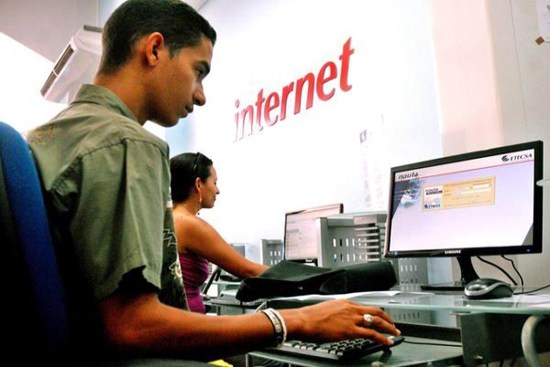
Cybercafe

Libraries: the Dirty but Effective Word in Public Access to ICT

future telecenter
Is this the library the future of public access ICT after cybercafes and telecenters?

Back when Bill Gates was young, he had multiple opportunities to geek out - he had access to computers at home and at school - but he would sneak out of his house to go the library. Why? Because he loved the wealth of knowledge, curated and guided by libraries.

With that background, it's easy to see why the Bill and Melinda Gates Foundation has a strong focus on libraries. And that many communities have a library and it's seen as a knowledge repository already, makes it also easy to see why the Gates Foundation has added public access to ICT as a tenant of their library support. ICT-enabled libraries can provide guided access to the wealth of information that computers and the Internet can bring to young minds.

"Library" as a dirty word

Yet, let's be honest - what comes to mind when you read the word "library" or "librarian"? Long nights spent in the library as a youth, with an ever-present librarian quick to squelch any study-break frivolity. Not as a 21st Century guide to personal life-long knowledge or greater community development. This is true around the world, as EIFL found:

Most people in six African countries believe public libraries have the potential to contribute to community development in important areas such as health, employment and agriculture. However, libraries are small and under-resourced, and most people associate them with traditional book lending and reference services rather than innovation and technology.

In fact, say the word "library" in international development or technology circles and instantly half the room is bored or tunes out.

Libraries are the most effective public access to ICT

Communities need access to the benefits and services only found online but the ICT infrastructure is often prohibitively expense for individuals to buy for themselves. Mobile phones, while ubiquitous, do not provide for any meaningful depth of information acquisition - certainly not when compared to a computer. So we are looking at computer labs where the costs are best aggregated over entire communities.

As we all know, telecenters are not sustainable without donor funding, and local governments are loathe to add yet another infrastructure support demand onto their shrinking budgets.

Enter the library. Of all the public access to ICT models discussed at the Future of Public Access to Information Technology Salon, it was the library, or similar government-supported information infrastructure, that is the most viable, sustainable, and compelling model.

Governments already understand the need for libraries and their role in supporting them as a government-funded service. Adding ICT to the library model is a small marginal cost with great community development potential - even when the model doesn't look like a library at all.

Library Parks - a new public access model

library-parks.jpg

Enter the Parques Biblioteca or "Library Parks" of Medellin, Colombia. There, libraries are the anchor for multiple municipal knowledge and community building services (public park, library, information center, cultural center, and entrepreneurship incubator) to bring a concentrated development impact to the city's poor areas.

ICT access is a central resource that supports these activities, but not the only one. In addition, there is an acknowledged role for the librarian as a knowledge guide with technology. Colombians, just like others around the world (including "digital natives"), may not have the greatest media literacy. The librarian is seen (and trained) to be a modern knowledge guide, conversant in books and bytes, to help users navigate the still wild online world.

Do libraries need better marketing?

But if libraries are to be more than book repositories, should we start calling them something else besides a "library"? Could there be a need to re-brand the library as a "community knowledge center" or "life-long learning center" to show they are for more than just students studying? Or maybe "media centers" or "knowledge factories" to show they are more than just a collection of books? And can librarians move beyond being "martyrs to knowledge" and be more the learning facilitators we also hope teachers to be in 21st Century schools?

Knowledge is power and therefore libraries should be the cool thing in international development and technology circles. The still-open question is how can we get from the dim mental image of the past to the dynamic reality of the future?


.

Get ICTworks 3x a week - enter your email address:

Wayan Vota's picture

Wayan Vota

Inveneo

Wayan Vota is a technology expert focused on appropriate information and communication technologies (ICT) for rural and underserved areas of the developing world. He is a Senior Director at Inveneo and is the editor of ICTworks

Telecentres are NOT sustainable!

rwanda-internet-bus.jpg

Almost since the very beginning of Telecentres/public access centres the nagging from funders – mostly governments but major NGO’s as well – has been directed towards making sure that these would somehow/sometime become financially self-sustaining i.e. "sustainable". The idea was that once the initial investment had been made – mostly in providing hardware/software and some period of supported connectivity – that Telecentres would somehow magically be able to transform themselves into "social enterprises" which could get enough revenue from their local communities to:

  1. Pay salaries (and benefits) to staff
  2. Pay rent on buildings
  3. Cover access charges
  4. Cover charges for maintenance and replacement

Given that the Telecentres were established in the first place and located where they were precisely because the local population was for the most part poor, isolated, and other wise marginalized i.e. not in a position to pay for their own computers, Internet access etc. seems to have escaped the attention of those leading the demands for “sustainability”. That this sustainability was a more or less complete pipedream which any realistic assessment of the circumstances of Telecentres would have determined seems to have been overlooked as both funders and Telecentres themselves chose to hope somehow that the future reckoning in terms of funder expectations/Telecentre commitments would never arrive.

And so Telecentres have limped along without realistic plans for the future or sufficient funding to achieve even their modest goals and funders have turned to consultant study after consultant study to find the magic formula that would take off their hands/budgets this unwelcome dependency of providing internet and computer access to those on the other side of the “Digital Divide” i.e. those who for whatever reason were unable or unwilling to provide it for themselves.

To be very clear: certainly there are publicly accessible Internet centres in very many communities in all parts of the world. The most common name for them is Cybercafes. Cybercafes provide computer/Internet access primarily to young males to fulfill various fantasies via more or less violent games and other such pursuits. That it is widely headlined that these private enterprises have little or no redeeming social value (I won’t argue this at the moment) and certainly no value from a social or economic development perspective let alone resolving issues of a Digital or a Service Divide is almost unarguable.

The broader purpose of Telecentres was and remains to add value as social initiatives by governments or others by providing free or very low cost Internet access to low income populations, in remote regions, or for those with other forms of social disability that prevent broad participation in an increasingly digital society. If governments (or others) choose to de-fund existing Telecentres on the basis that they are saving them from the evil of “dependency” (or whatever) they should know that they are choosing to penalize precisely those whom they have otherwise identified as requiring support because of their social and economic circumstances.

Governments are not only unrealistic but they are deeply hypocritical in requiring communities in which they previously made these investments because of their overall lack of resources, to somehow now come up with the resources to support these facilities. One additional observation, Telecentre funders repeatedly confuse the issue of Telecentre utilization rates with the issue of funding and sustainability.

Cybercafes have high utilization rates (or they don’t survive) precisely because they are market driven and thus provide the kinds of services on which those without significant financial responsibilities are prepared to spend their money—i.e. entertainment. Telecentres have or at least should have the mission of providing Internet enabled services and opportunities for access and use to those otherwise unable to obtain such access, make such use and thus achieve a degree of digital inclusion.

These services (which of course, will vary from locations to location) are responsibilities and goals for which government funds have been budgeted. Attempting to download responsibility and cost for the delivery of these services onto the poor and marginalized themselves – which the continuing chants for “sustainability” in fact are, is both the height of irresponsibility and the height of cynicism.

The challenge is to design and develop Telecentres which are embedded (“owned”) by local communities and which provide those communities with among other capabilities the variety of services and supports (as for example e-government, e-health, small business development and support) which they require and which otherwise, in the absence of the Telecentre, would be much less accessible and much more costly and difficult to obtain (and to deliver).

These are notes for a talk to be given by Mike Gurstein to an ITU sponsored workshop on Telecentre sustainability in Bangkok, May 23-25, 2011 and were published originally as Telecentres are not “Sustainable”: Get Over It!

Guest Writer's picture

Guest Writer

This Guest Post is a ICTworks community knowledge-sharing effort. We actively search for and re-publish quality ICT-related posts we find online. Please follow the link above to read the original article. If you'd like to suggest a post (even your own), please email wayan at inveneo dot org

Are Mobile Phones Pushing Cyber Cafes Out of Business?

When last did you visit a cyber cafe?

Eight years ago, my answer would have been “right now”. I would have been writing/reading this on a computer in a cyber cafe. Right now however, I am lying somewhere comfortable in my home, whilst punching the soft keys on my laptop.

Share

A few years ago in Accra, one could count more than ten Internet cafes between Vodafone (then Ghana Telecom)’s Head Office around Kwame Nkrumah Circle and BusyInternet on Ring Road Central. There were: True Internet, WWWPlus Mega Cafe, Krofa Internet Cafe, Java Internet Cafe, and several others, whose names I do not remember at this time.

Sadly, most of them have closed shop. Whilst several reasons could be offered for the failure of these enterprises, one cannot overlook the solid impact of mobile phones and mobile internet technologies.

My facebook profile on a Nokia smartphone

Mobile Websites

A quick glance at the traffic metrics website Alexa.com reveals that the most visited websites in Ghana include: Facebook, Yahoo, Google, YouTube, Live.com, Wikipedia, MSN, GhanaWeb, BBC. Email used to be the most popular online activity in this part of the world but social networking websites seem to have taken the lead in recent times. News websites come third. Thus, the composition of the ten most popular websites is not much of a surprise.

What is more interesting is that ALL the most popular websites have mobile versions of their services. Typing facebook.com into a mobile web browser for example, automatically redirects one to a mobile version of the popular social networking website. The mobile websites are stripped-down versions but offer a lot of functionality, in a layout small enough to fit into tiny mobile phone screens. It is thus now common place to find people get busy with chatting, twittering, reading the news & more, from their mobile phones.

Smartphones

Smartphones are raising the stakes and pushing more possibilities into our hands, literally. They now have enough processing power to stream high-definition video and enough memory to download and store databases of music, photos and videos from the Internet. Some smartphones come with full QWERTY keyboards and thus making typing a pleasure. Emailing, blogging, chatting can now be done virtually anywhere.

Lower entry costs

Personal Computers are no longer the exclusive preserve of the rich and well-educated. 10 years ago, the pricing of an average laptop was about $2,000. Not any more. New, more powerful, full-featured laptops are available today for as low as $700. Their smaller cousins (netbooks) even come at lower prices; mwave.com currently prices an ASUS EPC900B-BLU01X Eee netbook PC at only $209.99

Used and probably refurbished PCs even drag the entry costs lower, for obvious reasons.

USB Modems

Those little devices have further democratised internet connectivity. Where mobile phones and smartphones are not enough, one could easily buy a USB Modem for as low as 60 Ghana Cedis (about $42) and connect it to a desktop, laptop or netbook for a full Internet experience. MTN Ghana is currently offering their USB modem at that price. Gone are the days when one needed to obtain a hard-to-comeby fixed phone line from the telecom monopoly or a fixed wireless antenna pointed at the Internet Service Provider’s radio mast, or a VSAT satellite dish + modem. None of these came cheap.

The more spectacular thing is that 3.5G USB modems offer real broadband speeds today.

Back to those cyber cafes. The rapid closure of cyber cafes is not limited to Ghana. 234Next.com, a leading Nigerian news source, today published a report titled: Cyber cafes are vanishing:

"In those days, around 2000 and 2001, I used to go to cyber cafe, pay money to check my yahoo email. You know the feeling that time was powerful. I was the only one who could browse amongst my friends then. We will go to a cyber cafe and crowd around one system, five of us, and then the systems were always very slow, so if we hear that one cyber cafe somewhere was fast we will go there," said Solomon Edema, a computer engineer. "Now, all of us browse with our phones. I also used my laptop. I have not gone to a cyber cafe for over a year now," Mr. Edema, adds.

Nowadays, the proliferation of computers and 3G mobile phones, including the famous China phones, has resulted in cheaper prices. As a result more people can afford internet-enabled phones. Similarly, the competition in the telecom industry has also led the telecom firms out-doing one another in offering cheap modems and internet access. Traders at Computer Village, Ikeja, now offer software that enable free internet access on laptops and mobile phones.

It is clear that mobile phones, are pushing cyber cafes out, the same way public phone booths and “communication centres” have become endangered species. What waits to be seen is how long the few cyber cafes that remain would last. Would they close shop or evolve their business model? Time would tell.


.

Subscribe to Ictworks - enter your email address:

Oluniyi Ajao's picture

Oluniyi Ajao

Web4Africa Ltd.

I am an Internet entrepreneur & technology enthusiast with strong interests in web design & hosting, writing about mobile communications technologies, and blogging.

How to Fundraise Money for Computer Labs and Internet Cafes in 3 Easy Steps

Do you want to deploy a computer lab as part of your organization's programs? Yet, are you lacking the cash to pay for the technology yourself? Here is a quick guide on how to raise money for an Internet Cafe from individual donors in 3 steps:

Share


1. Have a clear pitch for your computer lab

The world is a busy place. You want to capture your potential donor's attention quick and hook them on your idea fast. Here's a great example of using YouTube to do just that - ProjectFOCUS' Bringing Solar Internet To Rural Uganda:

Note how ProjectFOCUS shows just the long-term benefits of the computer lab - health, education, economic development. They don't dwell on the features - number of computers, type of software, etc - but give donors the big, uplifting picture.


2. Have a clear fundraising goal

Individual donors want to feel like they are contributing to an achievable goal. Show them what the goal is, and better yet, show them how you came up with the goal. Again, ProjectFOCUS does that really well with their project goals:

Short Term
Project Focus is partnering with local organizations in rural Southwest Uganda to launch an Internet Café, providing access to information and communication previously unavailable to residents of the region. The Café will also provide technology skills training, a revenue source for a local community-run primary school, and allocate space and tools for the production of creative multi-media projects.

Mid Term
The next stage may include the establishment of additional art-therapy/creative media projects, water and sanitation projects, an earth-brick income generation project, and other ideas coming from community members.

Long Term
The long-term vision embodies continual support of holistic, sustainable, community-driven initiatives in the areas of education, health care, economic development, and psychosocial needs in the community.

Even better, they also give donors and understanding of the detailed costs of the computer lab (PDF). This way, donors feel confident that their donation will cover all the needs of the Internet cafe.


3. Have an easy way to donate

It may seem common sense to make it easy for people to send you money, but too often I see donation requests leading to an email address or requests for checks(!). So let's look one last time at ProjectFOCUS - this time at their website header, and note the call to action right at the top:

projectfocus.jpg

The "Invest Now" is a great way to make donors feel engaged in a beneficial, long-term project (vs. "donate now") and it links directly to a PayPal donation page. You can also use Google Checkout or even Global Giving. The point is to make it easy to give.


.

Subscribe to Ictworks - enter your email address:

Wayan Vota's picture

Wayan Vota

Inveneo

Wayan Vota is a technology expert focused on appropriate information and communication technologies (ICT) for rural and underserved areas of the developing world. He is a Senior Director at Inveneo and is the editor of ICTworks

Mkahawa: Open Source Internet Cafe Billing and Management Software

Are you looking for an Open Source billing software for a cybercafe? Then look no farther than Mkahawa - an open-source project that builds on Cafe Con Leche or CCL, and extends CCL's traditional cross-platform nature, simplicity, lightness and speed.

Mkahawa's speed and small memory foot-print comes from the fact that it is built in C and C++ and can run on Linux, Windows and MacOS.

More info on Mkahawa

Hat tip to Danny Aerts

Wayan Vota's picture

Wayan Vota

Inveneo

Wayan Vota is a technology expert focused on appropriate information and communication technologies (ICT) for rural and underserved areas of the developing world. He is a Senior Director at Inveneo and is the editor of ICTworks

Syndicate content